
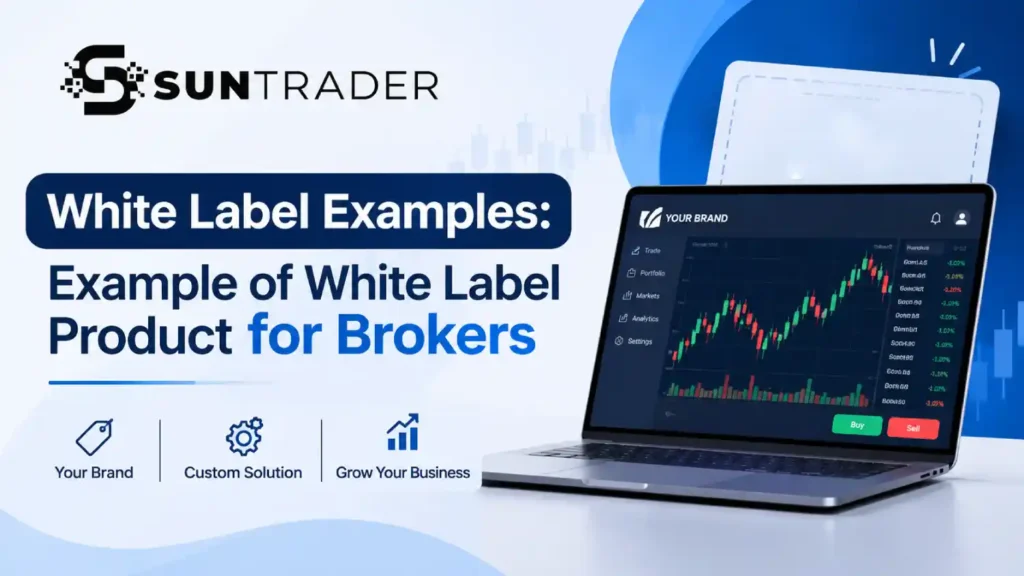
Most people have used a white label product without knowing it. The store brand cereal in your kitchen, the banking app on your phone, even the trading terminal your broker gives you could all come from a company whose name never appears on the screen. For brokers, this model is a real shortcut. You can launch a full trading platform under your own logo, and your clients never need to know who built the engine. Suntrader works exactly this way for more than 50 brokers, and a launch can happen in about one week. Below, you will find clear white label examples from different industries, a practical example of a white label product in trading, and a straight look at how Suntrader fits a brokerage like yours.
What Is a White Label Product?
A white label product is made by one company and sold by another under its own name. The seller adds a brand, a price and a customer experience. The maker handles everything else.
People often mix this up with two similar terms, so here is the difference:
- White label: one product is offered to many businesses, and each one rebrands it.
- Private label: a product is made for one retailer only.
- Reselling: the seller keeps the original maker’s name on the product.
Businesses pick white label because it saves money, time and risk. You do not hire a development team or wait through a long build. You start with a working product and focus on selling it.
White Label Product Examples You Already Know
The idea becomes easier to grasp when you look at real white label examples. These five show up in daily life.
- Retail store brands: a supermarket sells biscuits or detergent under its own label, while a large manufacturer produces them.
- Skincare and cosmetics: one lab creates a face cream, and several beauty brands sell it in their own packaging.
- Software tools: digital agencies often rebrand project dashboards or email tools and offer them to clients as their own service.
- Payment and banking apps: many fintech apps run on a provider’s technology, yet users only see the app’s name.
- Trading platforms: technology companies build the trading engine, and brokers offer it to traders as their own.
The pattern is the same every time. The product is generic, but the brand and the customer relationship belong to the seller. For a broker, that relationship is the most valuable thing you own, because client trust takes years to build.
Example of White Label Product in Trading
Say you run a growing brokerage. You want to give your clients a web terminal and a mobile app, but you have no in house tech team. Building both from zero would take months, a large budget and a lot of testing before a single client could place a trade.
A white label trading software provider removes most of that work. You add your logo, your domain and your colors. Your clients log in and see your brand on every screen. Behind that screen, the provider runs the trading engine, the servers and the order processing.
So the split looks like this:
- Your clients see: your name, your web app, your mobile app and your login page.
- The provider handles: the engine, the infrastructure and the technical upkeep.
Suntrader follows this model. Your brokerage gets the branded front end, and the Suntrader team keeps the technology running underneath.
How the Suntrader White Label Platform Works for Your Brokerage
Suntrader is built for brokers who want a full trading business setup, not just a chart on a screen. Every point below comes from the platform’s own feature list.
- Full custom branding: the web based trading application carries your identity.
- One week go live: the technology is ready to use, so you can start onboarding clients quickly.
- Integrated broker tools and web CRM: you manage client accounts from one back office system.
- Advanced risk management: automated surveillance flags price manipulation and scalping.
- Global market connectivity: your clients can reach NSE, MCX, Forex, Crypto and US Stocks from a single terminal.
- Multi currency trading: traders can use their local currency, which keeps things familiar.
- Option chain and real time market data: useful for clients who trade derivatives and want deeper insight.
The platform also supports both B2B and B2C models. If you serve retail clients directly, it works. If you manage a network of sub brokers, it works there too. The interface stays clean, with a multi market watch, advanced positions and charting tools that suit beginners and experienced traders alike. In addition, a good interface matters more than most brokers expect, since clients who find a platform confusing rarely stay for long.
Why Brokers Trust Suntrader
Choosing a technology partner is a big decision, so it makes sense to ask for proof. Here is what Suntrader puts forward.
|
You do not have to take any of this on faith. The Suntrader team is easy to reach through the website, and you can ask direct questions about your setup before you commit to anything.
White Label vs Building Your Own Trading Platform
Many brokers wonder whether building in house is the better route. It can be, but only if you have the time and money to match. Here is how the two options compare.
- Launch time: a custom build can take many months. A white label platform like Suntrader goes live in about one week.
- Upfront cost: in house development needs developers, designers, testers and servers. White label lets you start with a far smaller commitment.
- Maintenance: with your own platform, your team fixes bugs and rolls out updates. With white label, the provider takes care of that.
- Risk and compliance tools: building surveillance and CRM tools from scratch adds more delay. Suntrader includes risk management and a web CRM from the start.
- Support: an in house system needs a staffed team. Suntrader offers a dedicated support team around the clock.
Building your own platform gives you total control, but it costs more and moves slower. White label gives you a proven system and keeps your brand in front of your clients, which is what most brokers actually need.
Conclusion
The white label examples above all point to one simple idea. You can sell a proven product under your own name and spend your energy on growing your client base. The clearest example of white label product in the broking world is a trading platform that carries your brand while a trusted provider runs the technology. Suntrader brings custom branding, CRM, risk management and global market access together in one package. Contact Suntrader & get your trading software live in one week.
FAQs
What is an example of a white label product?
Store brand groceries, rebranded software tools and broker trading apps are common examples. One company makes the product, and another sells it under its own name.
Can white label trading software be customized?
Yes. Suntrader offers full custom branding, so the platform reflects your business identity.
How long does a white label trading platform take to launch?
With Suntrader, the go live process takes around one week because the technology is ready to deploy.
Which markets can my clients trade?
Your clients can access NSE, MCX, Forex, Crypto and US Stocks through the platform.
