

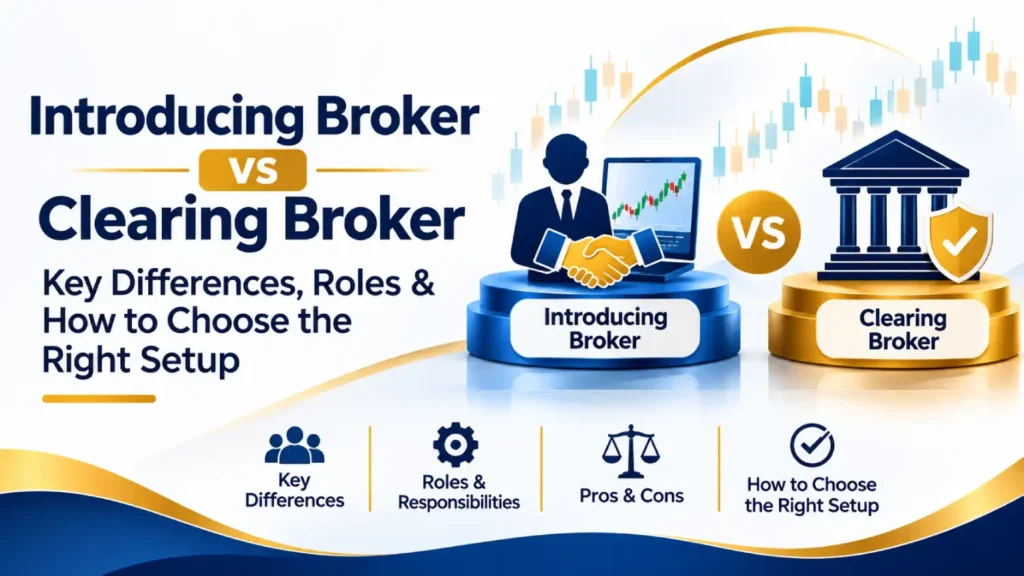
You can bring thousands of clients to a trading business and never hold a single rupee or dollar of their money. That is the core difference between an introducing broker and a clearing broker, and it shapes cost, control, and compliance for every brokerage. In short, the introducing broker owns the client relationship, while the clearing broker settles trades, holds assets, and manages margin. At SunTrader, we work with brokers who are deciding how to structure their business, so this guide explains the introducing broker vs clearing broker question in plain language and helps you choose a model that fits your goals.
Introducing Broker vs Clearing Broker: The Quick Answer
If you only have a minute, here is the short version. An introducing broker finds clients, opens their accounts, takes their orders & passes those orders to another firm. Moreover, a clearing broker processes those orders after execution, confirms the trades, settles them, and keeps custody of client funds & securities.
| Point | Introducing Broker | Clearing Broker |
|---|---|---|
| Client contact | Direct and ongoing | Mostly behind the scenes |
| Holds client funds | No | Yes |
| Settles trades | No | Yes |
| Regulatory load | Lighter | Heavier |
Moreover, the two firms depend on each other. The introducing broker brings the business & the clearing broker provides the infrastructure that keeps trades safe and legally settled.
What Is an Introducing Broker and What Does It Do?
An introducing broker, often called an IB, is a firm that deals with clients but does not carry their accounts. You can think of it as the front office of a brokerage. It handles onboarding, answers questions, shares market insights & simply accepts trade instructions.
Here are the main duties of an introducing broker:
- Client onboarding and account opening support
- Advice and service, depending on the licence it holds
- Order taking and order routing to a clearing partner
- Ongoing relationship management with active traders
What an introducing broker does not do is just as important. It does not hold client assets, and it does not settle trades. For example, a regional brokerage may serve a few thousand retail traders in its own market. It sends every order to a larger clearing firm and spends its energy on education, support and growth. Therefore, its capital needs stay lower and its launch time stays shorter.
Clearing Broker Role: Trade Settlement, Custody and Margin
A clearing broker, also known as a clearing firm, works on the other side of the trade. Once an order is executed, the clearing firm confirms the details, moves the money and securities, and records the final ownership. In addition, it holds client assets and calculates margin requirements.
The clearing broker role usually covers these areas:
- Trade settlement and confirmation
- Custody of client funds and securities
- Margin and risk monitoring
- Regulatory reporting and record-keeping
Because of this responsibility, clearing firms face strict capital rules and close regulatory oversight. Consider a simple trade. A client buys shares through an introducing broker; the order reaches the exchange and gets filled, and the clearing broker then settles the payment and delivers the shares to the right account. The client sees a smooth experience, while the clearing firm does the heavy lifting in the background.
How Introducing Brokers and Clearing Brokers Work Together
The relationship between the two firms is built on an agreement. Here is how a typical trade flows:
- The client places an order with the introducing broker.
- The introducing broker routes the order to the exchange or liquidity venue.
- The trade is executed.
- The clearing broker confirms, settles, and records the trade.
- The client receives statements and confirmations.
Two arrangements matter most here. In fully disclosed clearing, the clearing broker knows each client by name and carries each account separately. The introducing broker still manages the relationship, but the clearing firm keeps detailed records. In an omnibus arrangement, the introducing broker holds one combined account with the clearing firm and keeps its own records of individual clients. Omnibus setups give the introducing broker more control, but they also add more responsibility.
Furthermore, the written agreement should state clearly who handles client funds, who produces statements, who handles complaints, and who carries each compliance duty. Unclear responsibilities are one of the most common sources of disputes between these firms.
Key Differences: Custody, Compliance, Costs & Client Ownership
Now let us look at where the two roles separate most clearly.
- Custody: The clearing broker holds client assets. The introducing broker does not.
- Capital requirements: Clearing firms must maintain much higher capital. Introducing brokers can usually start with less.
- Regulatory burden: Clearing firms handle settlement rules, segregation of funds, and detailed reporting. Introducing brokers focus on conduct, licensing and client protection.
- Cost structure: Introducing brokers pay clearing fees to their partner. Clearing firms carry the cost of systems, compliance staff, and capital.
- Client ownership: The introducing broker owns the relationship, brand and communication with the client.
- Scalability: An introducing broker can grow quickly because it depends on a partner’s infrastructure. A clearing firm scales through volume and technology investment.
In other words, the introducing broker trades control over settlement for speed and lower cost, while the clearing broker accepts more responsibility in return for revenue from clearing and custody.
Introducing Broker or Self-Clearing Broker: Which Model Fits You?
A self-clearing broker does both jobs under one roof. It deals with clients and also settles its own trades. This model gives you full control, but it also demands more capital, more staff, and a heavier compliance structure.
Ask yourself these three questions before you decide:
- How much capital can you commit? If your budget is limited, the introducing broker route is usually more practical.
- How fast do you want to launch? An introducing arrangement lets you go live sooner because the clearing infrastructure already exists.
- How much control do you need? If you want to own settlement, custody, and every client record, self-clearing may be worth the investment in the long run.
Many brokerages start as introducing brokers and move toward self-clearing only after they build steady volume. Consequently, the choice is rarely permanent. It is a stage in the growth of the business.
How SunTrader Supports Introducing Brokers & Clearing Workflows
Choosing a structure is only the first step. You also need technology that supports it day after day. This is where SunTrader fits in. SunTrader provides trading technology that helps broker businesses launch and manage their services without building everything from scratch.
Here is how SunTrader can support your brokerage setup:
- Trading platform access for your clients across multiple asset classes
- White-label brokerage options, so your clients see your brand while the technology runs in the background
- Order routing & connectivity, which helps you work smoothly with your chosen clearing partner
- Moreover, Back office & reporting tools that simply make client management & record-keeping easier
- Faster setup, so you spend less time on technical work and more time on clients
Moreover, a well-built platform reduces errors between the introducing broker and the clearing firm. Clean order data, clear reports, and reliable connectivity make settlement smoother and reviews easier. If you want to see which tools match your model, you can explore the full range of services on the SunTrader website.
Compliance & Risk Points to Check Before You Choose
Whichever model you pick, a few checks will protect your business and your clients:
- Verify licensing. Confirm which registrations your local regulator requires for an introducing broker or a clearing firm. In the United States, for example, bodies such as the SEC, FINRA, CFTC and NFA set the rules for different products.
- Review your clearing partner. Look at its financial standing, track record, and regulatory history before you sign.
- Define responsibilities in writing. Your agreement should name who holds funds, who handles reporting, and who answers client complaints.
- Check fees closely. Clearing charges, platform fees, and connectivity costs add up over time.
Please note that this article is for educational purposes and is not legal or financial advice. Rules differ by country and by product, so you should speak with a qualified professional before making a final decision.
Read More : Top Trading Platforms for Brokers
Conclusion
The introducing broker vs clearing broker decision comes down to one question: who should carry the weight of custody and settlement in your business? An introducing broker focuses on clients, service, and growth, while a clearing broker focuses on settlement, safety, and compliance. Choose the model that matches your capital, your timeline, and your long-term plans. Furthermore, remember that the right technology makes either model easier to run. SunTrader is ready to support your brokerage with reliable trading tools and flexible setup options. Visit suntrader.site to explore the platform and talk to our team today.
FAQs
Can an introducing broker also be a clearing broker?
Yes, but then it is usually called a self-clearing broker. It takes on custody, settlement, and the higher compliance load.
Does a clearing broker deal directly with clients?
Generally no. The introducing broker manages the relationship, although the clearing firm may send statements and confirmations.
Which is more expensive to run?
A clearing firm costs more because of capital, systems, and compliance requirements. An introducing broker pays fees to its clearing partner instead.
Do I need a clearing broker to launch a brokerage?
In most cases, yes, unless you plan to clear your own trades. Most new brokerages partner with an existing clearing firm.
