

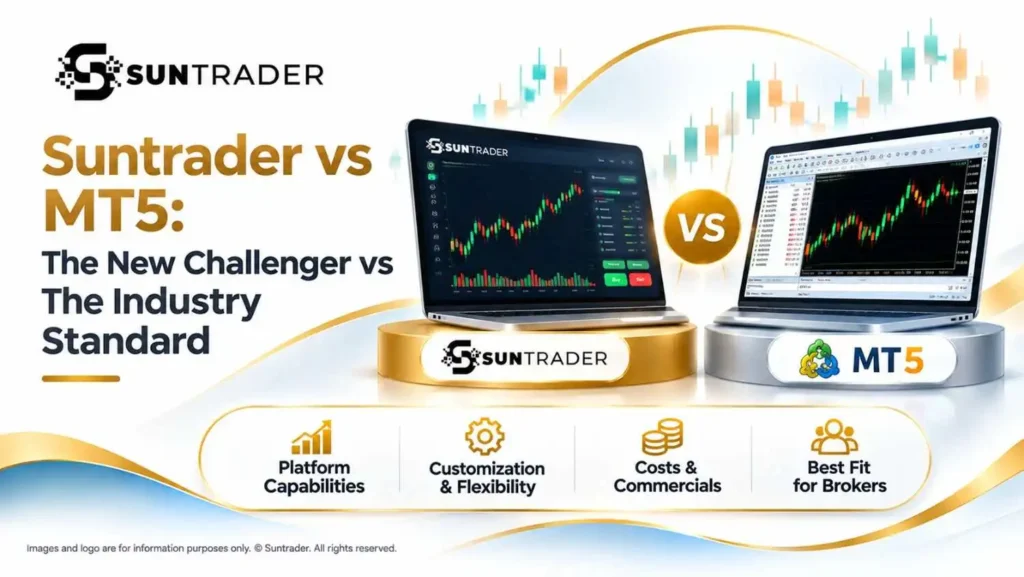
If you are launching a brokerage, someone will tell you to use MetaTrader 5. It is the default. It is the terminal that most traders know, and it comes with a massive ecosystem of custom indicators and algorithmic trading tools. But the market has changed. Getting your hands on an MT5 white label is no longer as simple as writing a check. And the total cost of ownership has ballooned.
This is where the Suntrader vs MT5 comparison gets interesting. MT5 is the industry standard for a reason. But if you are a business owner trying to launch a new brokerage in 2026, the standard path is expensive and restrictive. Suntrader offers a different route: a fully bundled B2B trading platform with zero recurring fees and a one-week launch timeline.
The Core Difference: Terminal vs Full Stack
The easiest way to understand this Suntrader vs MT5 comparison is to look at what you are actually buying.
MT5 is a trading terminal and the backend infrastructure that powers it. It is the engine. It gives your clients the charts, the order execution, and the algorithmic trading capabilities they expect. But MT5 does not give you a client relationship management (CRM) system. It does not give you a built-in risk engine. Those are separate products you have to buy and integrate.
Suntrader is a full stack. It is the terminal, the broker CRM, and the risk management system in one package. When you sign up, you are not just getting a place for clients to place trades. You are getting the back office to manage them and the surveillance tools to monitor them.
The MT5 Reality in 2026: The White Label Squeeze
The biggest hurdle with MT5 today is access. MetaQuotes stopped issuing new MT5 white label licenses in late 2022. If you want to launch on MT5, you cannot just apply to MetaQuotes. You have to go through an existing licensed provider, which adds a middleman, increases costs, and limits your control over the setup.
Even if you navigate the access issue, the pricing is front-loaded. The white label setup fee typically ranges from $5,000 to $15,000. The monthly license fee runs another $1,000 to $5,000. And that is just for the terminal.
To actually run a brokerage, you need the add-ons. A liquidity bridge to route trades will cost you $500 to $2,000 a month. A CRM will cost $500 to $1,500. Market data feeds will cost $300 to $1,500. When you stack the true all-in monthly cost, it ranges from $2,700 to $11,000. Your first-year bill can easily hit $30,000 to $150,000 before you have processed a single trade. For a startup, this is a massive barrier to entry.
What Suntrader Brings to the Table
Suntrader flips the financial model. Instead of charging you for software licenses and monthly maintenance, the platform runs on a revenue share.
The White Label Platform costs $3,000 to set up, and that payment is credited back to you as 15,000 points. After that, the platform fee is zero. There are no recurring fixed charges. Instead, Suntrader takes a 20% revenue share on the trades your clients execute. If your brokerage does not make money, Suntrader does not make money.
For that entry price, you get the full stack. The web-based trading application comes with full custom branding. The integrated broker CRM handles onboarding, deposits, and lead tracking. The risk management module includes automated surveillance for price manipulation and scalping. It connects to NSE, MCX, Forex, Crypto, and US Stocks.
The performance specs match what you need for a modern broker. Suntrader states its engine processes orders with 0.05ms latency, maintains 99.9% uptime, and has processed over $10 billion in volume. It is a complete B2B trading platform built to go live in a week. You get unlimited real accounts and dealers.
Where Suntrader Wins for the New Broker
If you are a new broker, Suntrader wins on capital preservation and speed.
The MT5 route requires a massive upfront investment. You have to pay setup fees, monthly licenses, bridge fees, and CRM fees just to open your doors. For a startup, that is a heavy cash burn before you have acquired a single client. Suntrader removes that barrier. You pay $3,000, you launch in a week, and your costs scale only when your revenue scales.
MT5 also forces you to be an integrator. You have to manage the relationship between your terminal provider, your CRM vendor, your bridge provider, and your liquidity provider. If something breaks, you have to figure out which vendor is responsible. Suntrader eliminates the multi-vendor headache. It is one platform, one support team, and one point of failure. For a lean startup, that operational simplicity is just as valuable as the lower upfront cost.
Where MT5 Still Wins
MT5 is not the standard by accident. If you are an established broker with a large IT team and an existing MT5 infrastructure, there is no reason to rip it out. The MT5 ecosystem is massive. It has over 80 built-in indicators and the MQL5 marketplace, where developers sell thousands of expert advisors and custom tools.
Serious algorithmic traders love MT5 because it allows them to build and test complex strategies. The platform has been battle-tested by thousands of brokers globally, and the liquidity depth it can handle is immense. Suntrader is newer. It does not have the same vast ecosystem of third-party plugins, and its market footprint is smaller.
If your clients demand specific MQL5 custom tools, or if you are looking to scale to millions of accounts instantly, MT5 is the safer, more proven bet.
Which Platform Fits Your Brokerage
The choice between Suntrader vs MT5 depends on your business model.
If you are an established broker with deep pockets and an existing IT infrastructure, stick with MT5. The ecosystem and the maturity are unmatched.
If you are a business owner launching a new brokerage, or migrating from a legacy system that is bleeding you dry in monthly fees, Suntrader is the logical choice. You get a modern, web-based terminal, an integrated broker CRM, and risk management in one bundle. You get a one-week go-live. And you get a pricing model that starts at $3,000 with zero recurring fees, aligning your costs with your actual revenue.
You do not have to take the risk of building the stack yourself. To see how the Suntrader vs MT5 platform fits your specific brokerage model, you can connect with the Suntrader team directly through the chat or call option on their site. They will walk you through the migration and launch process.
