

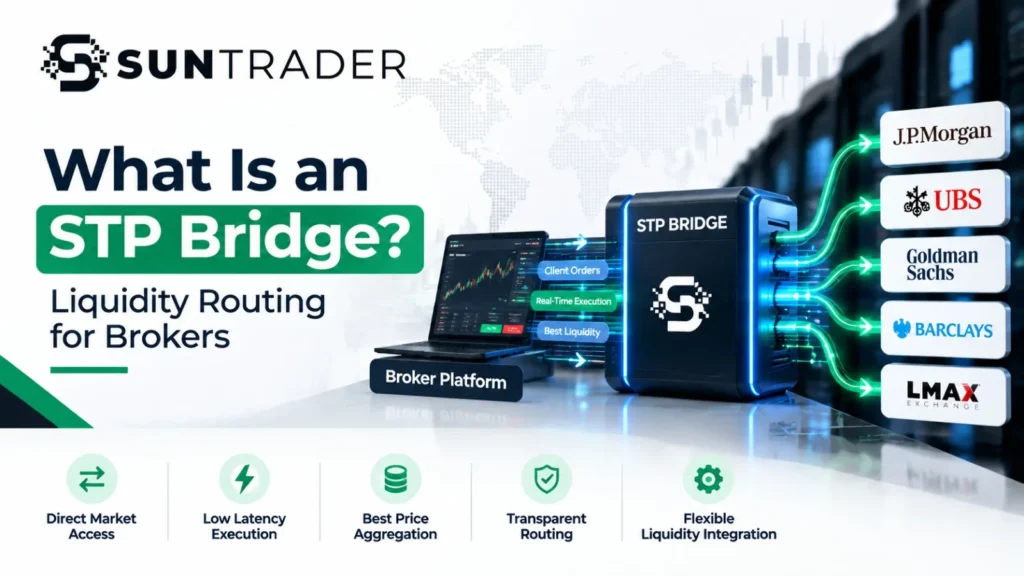
For brokers, taking a client order is only the beginning. That order may need to move between the broker’s trading platform, internal systems, and external liquidity providers. SunTrader provides broker-focused trading infrastructure where connectivity, risk management, CRM, and liquidity integrations form part of the wider technology setup.
An STP Bridge, or Straight Through Processing Bridge, can connect a broker’s trading environment with one or more liquidity providers and support configured order routing. Understanding how this technology works helps brokers evaluate liquidity connectivity, APIs, routing rules, and risk controls when building or upgrading their trading infrastructure.
What Is an STP Bridge for Brokers?
An STP Bridge for brokers is a technology layer that connects a broker’s trading platform with external liquidity providers.
A simplified workflow is:
| Client Order → Trading Platform → STP Bridge → Liquidity Provider → Execution |
The bridge can facilitate the electronic exchange of order and execution information between connected systems. The exact workflow depends on the broker’s configuration, supported protocols, liquidity providers, and trading infrastructure.
An STP Bridge does not remove market risk or guarantee a particular execution price. Its primary purpose is technical connectivity and order routing.
How Does an STP Bridge Work?
When a client places an order, the order first reaches the broker’s trading environment. The bridge then processes the routing request according to configured rules and sends it to a connected liquidity provider.
The basic process is:
- The client submits an order through the trading platform.
- The broker’s system passes the order to the bridge.
- The bridge routes the order according to the configured setup.
- The liquidity provider processes the request.
- Relevant execution information is communicated back to the broker’s system.
This automated workflow can reduce the need for repetitive manual order handling.
What Is Liquidity Routing for Brokers?
Liquidity routing is the process of directing broker orders toward connected liquidity sources.
A broker’s routing setup may involve:
- Liquidity providers
- Routing rules
- API or FIX connectivity
- Supported instruments
- Order types
- Risk controls
- Monitoring systems
Brokers using multiple liquidity providers may configure different routing arrangements depending on their instruments, providers, and operational requirements.
How Does Liquidity Provider Connectivity Work?
An STP Bridge needs compatible technical connections with the liquidity providers used by the broker.
These connections may involve APIs, FIX, or other supported protocols. Before implementation, brokers should confirm:
- Which liquidity providers are supported
- Which protocols are available
- What instruments can be connected
- How routing rules are configured
- What authentication and security requirements apply
- How monitoring is handled
Multiple liquidity provider connectivity can give brokers more infrastructure options, but the actual routing behavior depends on the broker’s configuration and provider setup.
Why Do Brokers Use an STP Bridge?
An STP Bridge can support several parts of broker operations.
-
Automated Order Routing: Configured workflows can reduce repetitive manual order handling.
-
Liquidity Connectivity: The bridge can provide a structured connection between the broker’s trading environment and external liquidity providers.
-
Multiple Liquidity Sources: Where supported, brokers can connect with multiple liquidity providers and configure routing according to their infrastructure requirements.
-
Operational Efficiency: System based communication can help organize order and execution workflows across connected platforms.
These benefits depend on the bridge, integrations, configuration, and liquidity providers involved.
Where Does an STP Bridge Fit Into Broker Infrastructure?
An STP Bridge is one component of a wider broker technology stack.
A simplified setup can look like:
| Trading Platform → STP Bridge → Liquidity Providers |
Other systems may include:
- CRM
- Risk management
- Account management
- Market data
- Admin and dealer tools
- Payment and KYC integrations
- Reporting
This means brokers should evaluate an STP Bridge as part of their overall infrastructure rather than as a standalone solution.
How SunTrader Supports Broker Infrastructure
SunTrader focuses on broker oriented trading technology and provides tools covering trading, CRM, risk management, market connectivity, account management & API integrations.
Its website states that its APIs can integrate with liquidity providers, payment gateways, and KYC providers. SunTrader also describes broker features including multi account management, admin and dealer controls, and customizable trading conditions.
For brokers, these capabilities can be considered alongside liquidity connectivity when planning a broader trading infrastructure.
What Should Brokers Check Before Choosing an STP Bridge?
Before selecting an STP Bridge, brokers should review:
- Liquidity provider compatibility: Confirm that required providers can connect with the system.
- API and FIX support: Check whether supported protocols match provider requirements.
- Routing configuration: Understand how orders can be assigned and routed.
- Risk management: Check how the bridge fits into existing risk controls.
- Monitoring: Review tools for tracking connections and order activity.
- Scalability: Consider future client, instrument, and liquidity requirements.
- Security: Evaluate authentication, permissions, and system protection.
Common STP Bridge Challenges
An STP Bridge does not eliminate every brokerage risk. Potential challenges include:
- Liquidity provider dependency
- API or FIX compatibility issues
- Incorrect routing configuration
- Connectivity interruptions
- Execution and market risks
- Integration and maintenance requirements
STP Bridge vs Manual Order Routing
| Factor | Manual Routing | STP Bridge |
| Order handling | More manual involvement | Configured system based routing |
| Liquidity connectivity | Operationally managed | Technically integrated |
| Routing | Manually directed | Rule based |
| Scalability | More operational effort | Supports automated workflows |
| Monitoring | Depends on broker systems | Can integrate with monitoring tools |
The actual results depend on the broker’s technology, configuration, liquidity providers, and operating procedures.
How We Evaluate STP Bridge Information
When evaluating an STP Bridge, brokers should distinguish between documented features, configuration dependent capabilities, and general industry concepts.
Technical claims about liquidity connectivity, supported protocols, execution, latency, or performance should be verified with the relevant technology provider and liquidity providers.
In addition, this approach helps brokers make infrastructure decisions based on documented capabilities rather than marketing terminology alone.
Read More Blogs :
1. SunTrader at Forex Expo Dubai 2026
2. Understanding White Label Products
FAQs
Q1. What is an STP Bridge?
Ans: An STP Bridge is a technology layer that facilitates communication and order routing between a broker’s trading environment and connected liquidity providers.
Q2. How does an STP Bridge route orders?
Ans: It routes orders according to the broker’s configured rules and connected liquidity provider setup.
Q3. Can an STP Bridge connect multiple liquidity providers?
Ans: Some bridge solutions support multiple liquidity provider connections. The available options depend on the technology and implementation.
Q4. Is an STP Bridge the same as a trading platform?
Ans: No. A trading platform provides the trading environment, while an STP Bridge primarily facilitates connectivity and order routing between systems.
Q5. What should brokers check before choosing an STP Bridge?
Ans: Brokers should check provider compatibility, API or FIX support, routing configuration, risk controls, monitoring, scalability, and security.
Final Takeaway
We have discussed that, an STP bridge is a technology component that supports automated order processing within a broker’s execution infrastructure.
Its functions can include order routing, liquidity aggregation, message normalization, execution handling, and integration with risk and reporting systems.
For brokers evaluating this technology, the focus should go beyond terms such as “STP” or “low latency.” Platform compatibility, routing flexibility, liquidity arrangements, API support, risk integration, monitoring, reconciliation, scalability & operational reliability all deserve consideration.
For a broader broker technology setup, SunTrader’s simply focus on trading infrastructure, APIs, market access, risk management, CRM & broker tools provides a wider framework in which STP and liquidity-routing requirements can be assessed.
[ Log In Our Website ]
