

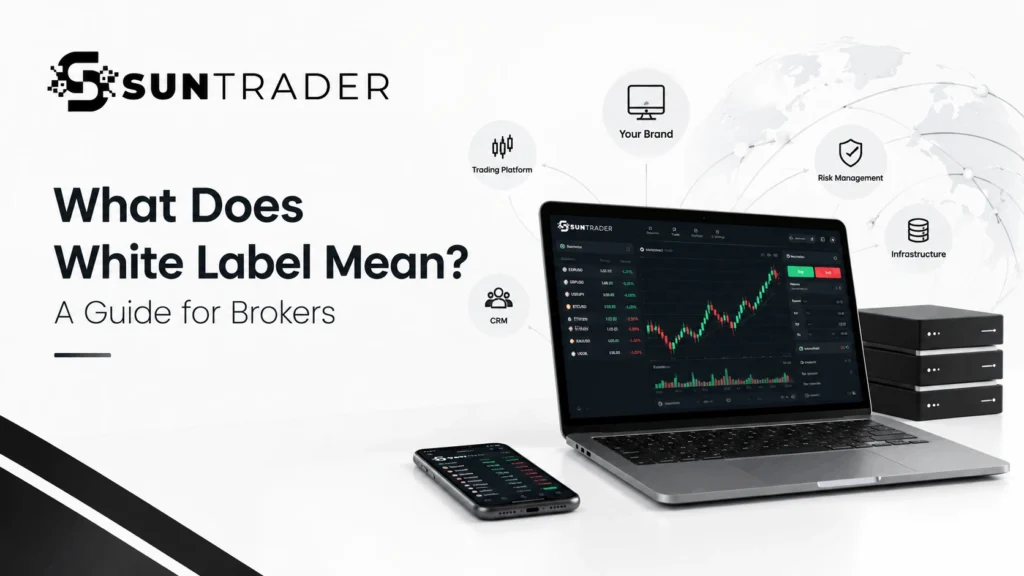
Launching a trading business can involve much more than creating a website and choosing a brand name. A broker also needs trading technology, client management tools, market connectivity, risk controls, integrations, and a reliable infrastructure to bring everything together.
So, what does white label mean in this context?
White label means using a product or technology developed by another company and offering it under your own brand. In the trading industry, a white label trading platform allows a brokerage or financial business to provide a branded trading environment without having to develop the entire technology stack from scratch.
For businesses exploring this model, SunTrader provides white label trading technology designed around branded platforms, CRM, risk management, market connectivity, APIs, and other brokerage infrastructure.
What Does White Label Mean?
The term white label refers to a business arrangement where one company develops a product or technology, while another company uses it under its own brand.
Think of it this way:
- Technology provider → White-label solution → Your branding → Your clients
The underlying technology is provided by a specialist company, but the customer-facing experience can be presented as the brokerage’s own.
For example, instead of spending significant time and resources developing a trading platform, CRM and supporting infrastructure internally, a brokerage can work with a white label provider and configure an existing technology solution around its business requirements.
This does not simply mean adding a company logo to software. Depending on the provider and agreement, white label solutions can include platform branding, client management, risk tools, APIs, market connectivity, payment integrations, and back-office functionality.
That makes the white label model particularly relevant to businesses that want to establish or expand a trading operation without building every technical component themselves.
What Does White Label Mean for a Broker?
For a broker, white label generally means using existing trading technology while presenting the client-facing platform under the broker’s own business identity.
Instead of developing every component internally, the broker can use technology supplied by a specialist provider. The broker can then focus more heavily on areas such as client acquisition, customer support, operations, business development and its overall trading offering.
A white label brokerage may therefore have its own:
- Brand identity
- Client-facing trading environment
- Website and customer experience
- Account structure
- Business operations
- Client support
while relying on a technology partner for some or all of the underlying infrastructure.
It is important to understand that white label technology does not automatically provide regulatory authorisation. Technology provision and regulatory responsibilities are separate matters, and a business needs to understand the rules applicable to its jurisdiction and business model.
How Does a White Label Trading Platform Work?
A white label trading platform generally works by combining an existing technology infrastructure with the branding and operational requirements of the brokerage.
1. Select the technology
The business first identifies the platform capabilities, markets, integrations and operational tools it requires.
2. Apply the brand
The technology can then be configured around the brokerage’s identity. Depending on the solution, this may include branding elements and other client-facing settings.
3. Configure trading functionality
The business can determine relevant account settings, instruments, trading parameters and other requirements supported by the platform.
4. Connect supporting systems
A trading operation often requires more than a trading interface. Integrations can include liquidity providers, CRM systems, KYC services, payment solutions and APIs.
5. Launch and manage the operation
Once the technology and integrations are configured, the brokerage can provide its clients with access to the branded trading environment while the technology provider supports the underlying infrastructure according to the service arrangement.
The exact process varies between providers, so businesses should understand what is included before selecting a white label solution.
What Is Included in a White Label Brokerage Solution?
A professional white label brokerage solution can cover several parts of a trading business’s technology infrastructure.
1. Branded Trading Platform
The trading environment is one of the most visible parts of the solution. A white label platform allows the brokerage to provide clients with a trading experience associated with its own brand.
2. CRM and Back Office
A CRM can help manage client information, onboarding workflows and communication, while back-office tools can support administrative and operational activities.
3. Risk Management
Risk management technology can help businesses monitor trading activity, exposure, margin requirements, and other relevant parameters. The specific controls available depend on the platform and configuration.
4. Market and Liquidity Connectivity
Access to market and liquidity infrastructure is another important consideration. A suitable solution should support the connectivity requirements of the brokerage and its selected trading model.
5. APIs and Integrations
APIs can allow the platform to connect with external services and systems, including payment providers, KYC solutions, liquidity providers, and other third-party technologies.
The key point is that a white label solution should be evaluated as trading infrastructure, not simply as branded software.
What Are the Benefits of White Label Trading Technology?
For many trading businesses, the main attraction of white label technology is the ability to use established infrastructure instead of developing an entire technology stack internally.
1. Faster Market Entry
Using an existing platform can reduce the amount of development work required before a business can prepare its trading operation.
2. Lower Development Burden
Building a trading ecosystem internally can require significant technical resources. White-label technology can reduce the need to develop every component from the ground up.
3. Custom Branding
The business can build its client-facing experience around its own brand rather than presenting another company’s consumer identity.
4. Access to Established Technology
A specialist provider can offer existing trading infrastructure, integrations and technical capabilities that would otherwise need to be developed internally.
5. Easier Scaling
A suitable white label platform can provide infrastructure that grows alongside the business, although the actual scalability depends on the provider, architecture and service agreement.
6. More Focus on Business Operations
With technology development handled by a specialist provider, the brokerage can dedicate more internal attention to clients, support, operations and business development.
These are operational advantages, not guarantees of business success. A white label solution still needs to be matched with an appropriate business model, technology setup, regulatory framework & operating strategy.
White Label vs Building a Trading Platform From Scratch
One of the biggest decisions for a brokerage is whether to use white label technology or develop its own platform.
With a white label solution, the business starts with existing infrastructure. This can reduce development requirements and potentially shorten the path to deployment. However, the business may have to work within the provider’s technical architecture, integrations and available customisation options.
Building a platform from scratch offers greater control over the technology architecture and development roadmap. However, it also means taking responsibility for development, testing, maintenance, security, integrations and ongoing technical improvements.
Neither approach is automatically right for every business.
For a new or growing brokerage, white label technology can provide a middle ground: the business owns its brand and customer-facing operation while using existing technology instead of building every component itself.
How SunTrader Helps With White Label Brokerage Technology
For businesses exploring a white label broker model, the technology behind the brand is one of the most important considerations.
SunTrader focuses on providing trading technology that businesses can use to build a branded trading environment. Its offering brings together areas such as custom-branded trading, CRM, risk management, market connectivity, liquidity APIs & supporting integrations.
In addition, the objective is to give brokers and trading businesses access to the technology they need without requiring them to develop an entire brokerage infrastructure internally.
Depending on the business requirements, the technology stack can support areas such as:
- Branded web trading
- CRM and client management
- Broker and dealer tools
- Risk management
- Market connectivity
- Liquidity APIs
- Payment integrations
- KYC integrations
- Real-time market tools
- Back-office functionality
- Cloud-based infrastructure
For a business considering SunTrader, the important step is to assess which features and integrations are actually required for its specific operating model.
What Should You Check Before Choosing a White Label Provider?
Choosing a provider should involve more than comparing platform screenshots or branding options.
Before selecting a white label trading platform, you need to simply consider:
- Platform capabilities: Check whether the technology supports the markets, instruments & functionality your business requires.
- Branding flexibility: Understand how much of the client-facing experience can actually be customised.
- Risk controls: Review the available tools for monitoring exposure, margin, leverage & trading activity.
- Integrations: Confirm whether the platform can connect with your preferred liquidity, payment & KYC providers.
- Scalability: Ask how the infrastructure handles increasing client numbers and trading activity.
- Security and reliability: Understand the provider’s approach to infrastructure security, backups & service availability.
- Technical support: Clarify what support is available during implementation and after launch.
- Commercial terms: Review setup charges, recurring costs, integration fees & any additional expenses.
- Regulatory responsibilities: Clearly establish which obligations remain with your business and which services are provided purely as technology infrastructure.
This type of due diligence can simply help a business avoid choosing a solution based only on price or appearance.
Is White Label Right for Your Trading Business?
White label technology can be worth considering if you are launching a brokerage, building a fintech business, expanding an existing financial brand into trading, or looking for an alternative to developing a complete platform internally.
It can be particularly useful when the business wants control over its brand & client experience but does not want to take on the entire technical burden of building and maintaining trading infrastructure.
However, businesses that require complete ownership of their technology architecture or highly specialised functionality may prefer a custom-built solution.
The better question is not simply whether white label technology is cheaper. In addition, it is whether the solution provides the technology, flexibility, integrations, scalability, and operational control your business actually needs.
FAQs
Q1. What does white label mean?
Ans: White label means using a product, service, or technology developed by one company and offering it under another company’s brand. In trading, this commonly refers to a brokerage using existing trading technology under its own business identity.
Q2. What does white label mean in forex trading?
Ans: In forex trading, white label generally refers to a brokerage using technology & infrastructure provided by another company while presenting the trading service under its own brand. Moreover, the exact services included depend on the provider and agreement.
Q3. What is a white label trading platform?
Ans: A white label trading platform is an existing trading technology solution that can be configured and branded for another business. Likewise, it may include trading interfaces, CRM, risk management, APIs, market connectivity & other supporting infrastructure.
Q4. Is a white label brokerage the same as building your own brokerage platform?
Ans: No. A white label brokerage uses technology provided by another company, while a fully custom brokerage platform is developed & maintained specifically by or for the business. White label generally reduces the internal technology development burden.
Q5. Does white label technology provide a brokerage licence?
Ans: Not necessarily. A white label technology provider supplies technology & infrastructure, but regulatory authorisation is a separate matter. Moreover, businesses must determine the licensing & compliance requirements that apply to their particular jurisdiction and operating model.
